PANAMA CANAL
Friday December 14, 2012
Wow… what to say about TODAY? Well, aside from being one of the 7 wonders, we had the unique and AMAZING experience of passing through one of the continental divides: the Panama Canal today.
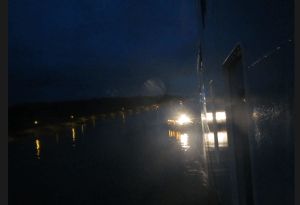
We stared our journey before first light. Around 5:30 this AM we heard the intercom announcement that we would commence proceeding through the Panama Canal .

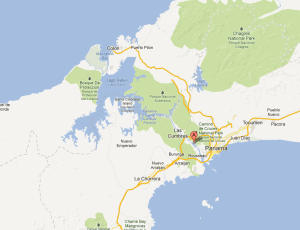
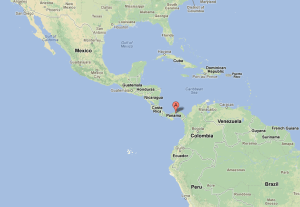
Interesting facts about the Canal: it was built almost 100 years ago (completed in 1913, opened in 1914). This modern marvel cuts straight through Panama, connecting the Atlantic to the Pacific while dividing North America and South America. The French first attempted to make it, but after a massive loss of life (over 25,000) and seven years, they gave up. It was only after a cure was discovered for malaria that, under American president Teddy Roosevelt (and American financier J.P. Morgan), the Panama Canal was restarted and then completed.
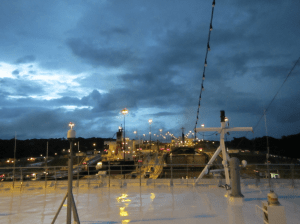

Boats that make the passage are charged two ways: the amount of water that they displace as well as number of passengers. For our ship, the MV EXPLORER the cost is about $300,000.00! The smallest amount ever paid was by Richard Halliburton. He swam the canal and paid out .36 cents in the early 1900’s. Between 42-44 ships make the voyage daily. It runs 24 hrs a day. And because we are close to the equator, there is never a time change. -So every day is the same. Which means every day from 6:30 AM and 6:30PM the Atlantic to Pacific trips take place. And from 6:30 PM to 6:30 AM the Pacific to Atlantic. This happens 365 days a year.
The Panama Canal earns about 1.2 million dollars a DAY in profit for the country of Panama.
The Canal cuts about 20 days of travel from maritime travel. And as 97% of all goods are transported via maritime (the sea), the amount of time and money that it saves ships (and the cost of goods) is HUGE.
The way it works:
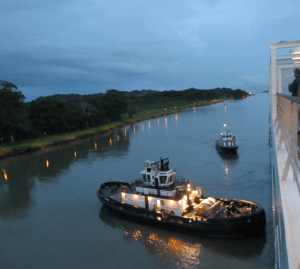
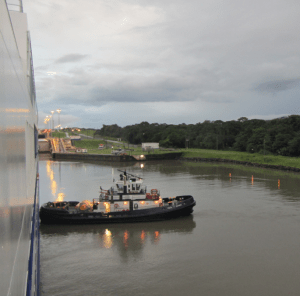
We enter from the Atlantic Ocean in the Caribbean Sea at Manzanilla Bay. And are greeted by a tugboat that will push us along in our journey. We will run our engines as well, but the tugboat is essential to make sure all goes smoothly.


First, a special Captain boards each ship that passes through. The Panama Canal is one of the only places where a Captain gives up his boat to another Captain. This is because it is so very important that the Captain who is steering the ship know exactly how do to it. Otherwise, the vessel could crash into the walls, or another ship. He will be our temporary Captain through-out our trip through the Canal, which will last about 8 hours.
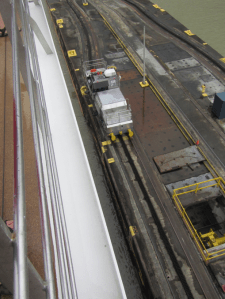
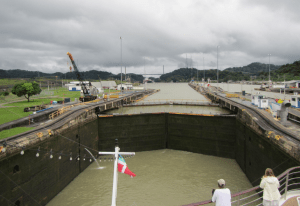
There are a series of THREE LOCKS that boats go through. One on one side of Lago Gutan and two on the other. Within each lock there are two sets of chambers. We are hooked up to a series of wire cables both FORE (front) and AFT (rear) by way of “railway” like box cars on either side, that helps to control and guide our ship as the water rises.
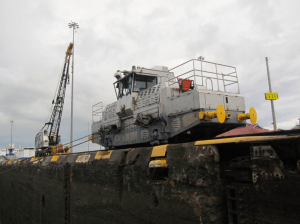
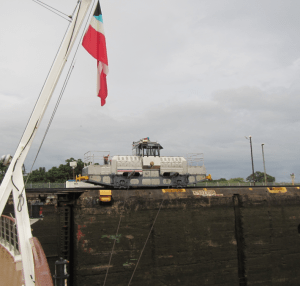
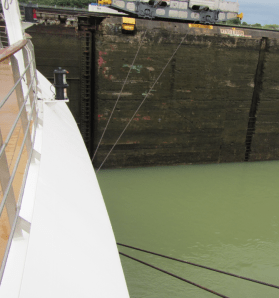
The tugboat is also tethered off, to make sure that the massive amount of water does not push her against the walls -and with only 2 feet of clearance on each side, there is no room for error!
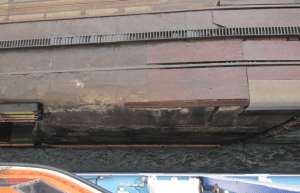
As our boat the MV Explorer enters, the chambers are closed behind and water rushes in and fills the chamber at a rate that raises our boat 3 feet per second.
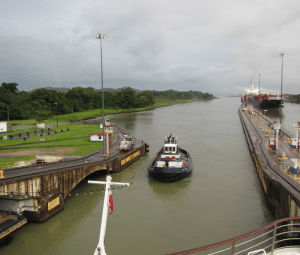
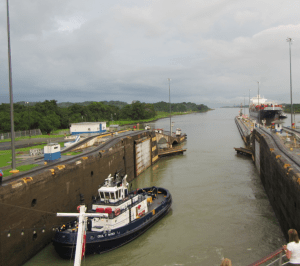
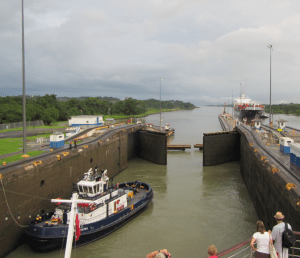
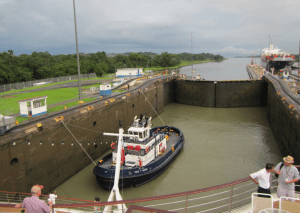
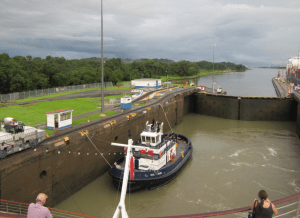
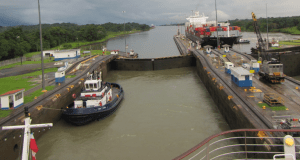
Our vessel then is lifted to the next height of the next level and we then proceeded to the next set of “locks” –and the process begins again.
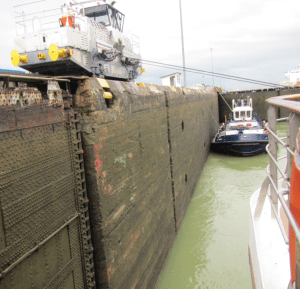


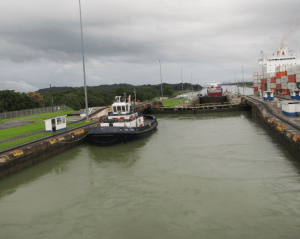
All the vessels then spill out into the man-made lake Lago Gutan (Lago means LAKE), where a control room organizes the ships and gives out orders as to which boats go through next, as only one ship can pass at a time. You can see them here all circling and waiting for their number to be “called”.

It takes quite some time, so we have time for a swim (with Nicky), a lecture on GORILLAS (which we’ll cover in the next post) and a couple of meals.
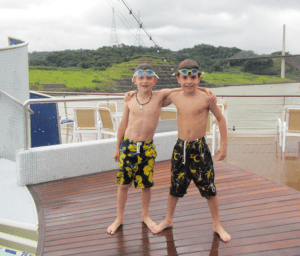
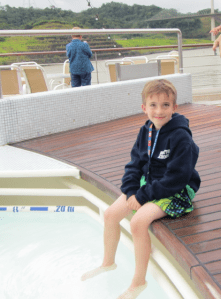
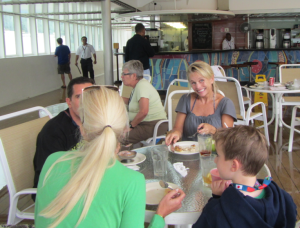
Now in the proper order, we travel down the narrow Gutan River.

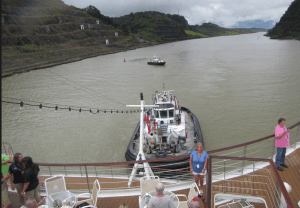
Along the way you can see the ridges cut into the sides of the shore. Whenever they need to drudge deeper (which is an ongoing thing, depending on how dry the “rainy season” is) they always start at the top first, then cut in these “notches” all the way down to the floor of the river, to prevent the walls from crumbling.
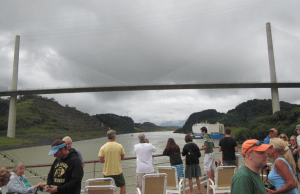
We pass under the Puente Centenario Bridge. -A beautiful expansion bridge that bridges two continents!
Finally, we navigate the narrow Pedro Miguel Locks and then wait for a moment at Lago Miraflores (a very small lake). Finally the last set of locks, the Miraflores Locks, pass under one more bridge (Puente de las Americas) and we emerge on the other side: the Pacific Ocean!
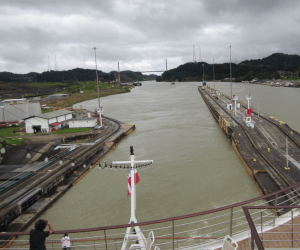
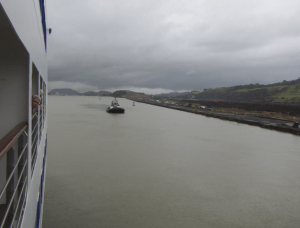
We say goodbye and thank you to our friendly tugboat and then we’re off!
Next: Ecuador!
Safe Travels!
JKLM
🙂
 leo and finn go to south america!
JKLM…so far, an incredible voyage…u can probably sell the DVD D&M J&G
OMG thank you for sharing all of this!!! What a wonderful experience for all. Take me next time! Love Ya, Your California Family, Happy Holiday….